
You are here: Home / Town Happenings / Bold Boulder: Lawn as Art by Alan Goya
Bold Boulder: Lawn as Art by Alan Goya
A Note About Our Stories: Boulder City Social celebrates the stories, memories, and folklore that make Boulder City unique. Some accounts have been passed down over the years and may include personal recollections or details that cannot be historically verified. These stories are shared for community and historical interest and do not necessarily represent the views or opinions of the Boulder City Chamber of Commerce or Boulder City Social.
This is the third in a series of articles featuring guest writer, Alan Goya. Alan is a long-time resident of Boulder City and somewhat of a raconteur who has collected a number of historical anecdotes about the people and history of our town.
Lawn as Art
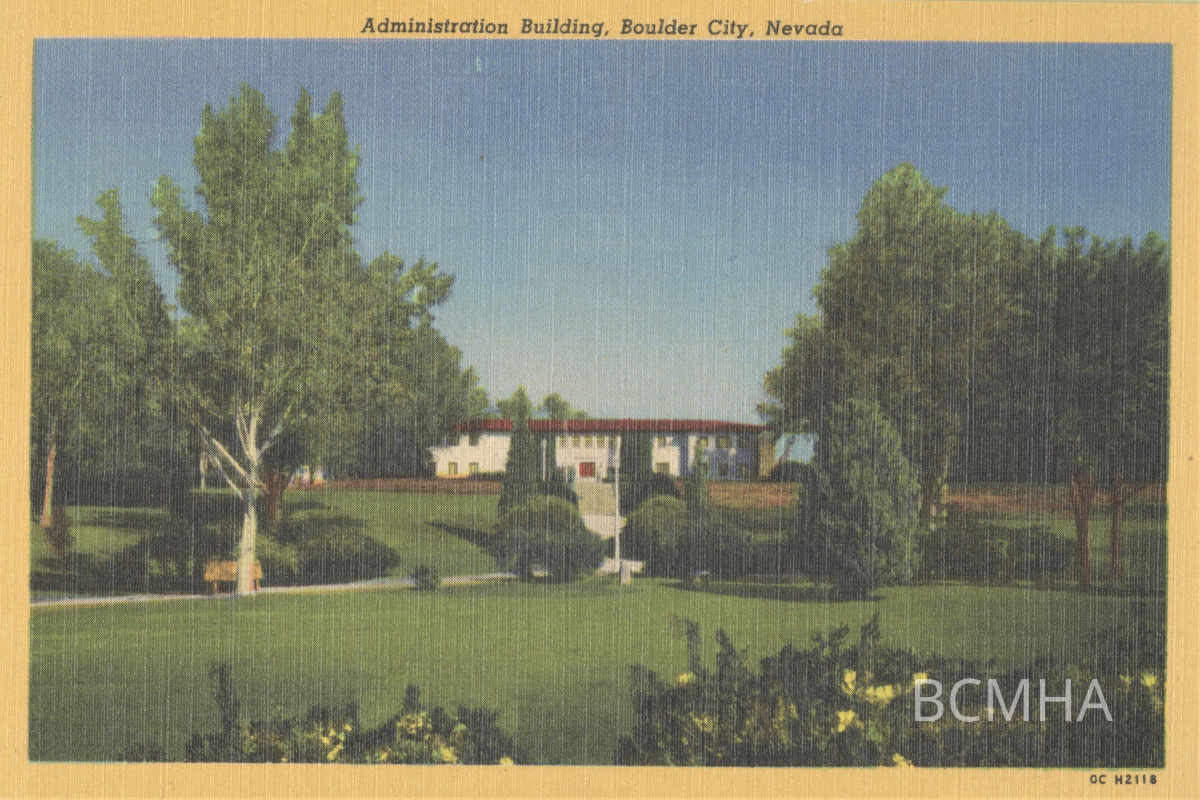
There was once a wonderful lawn in front of Sara Denton’s house and the Bureau of Reclamation Headquarters. It cascaded over the hill into Wilbur Square over Colorado and into Escalante Square.
Before there was shade there was grass. All the magnificent shade trees that would cool Boulder City for generations were mere saplings newly shoved into the Mojave Desert in 1932. Story goes that the first community Thanksgivings were held on the cool of the evening as great potluck affairs.
The green lawn and expressive concrete pathways are part of the historic north-south alignment of the Historic Bureau of Reclamation, visually and symbolically represents the Masonic Symbol of the all-seeing eye. The city’s shape, designed by progressive city planner Saco Rienk de Boer, resembles a pyramid. Similar to the reflection pond at Lincoln Memorial in Washington DC, the lawn is an integral part of the design and vision of the first planned community established by the government.
The construction of Hoover Dam was a unique period in history when art, engineering, and science collaborated to undertake an audacious construction project that transformed the world and paved the way for the American Century.
The history of Las Vegas goes beyond the much-touted springs that provided only enough water to establish a two-block paved town and a railroad water stop. The city’s growth and development truly began with the first water pumped from the Colorado River and stored in the tank on our hill. Our ornate Romanesque water filtration plant, located on the hill, served as a salvation for the city. The Bureau of Reclamation building, which provided employment during the Great Depression and laid the foundation for an incredible future, is a testament to this. We are the beneficiaries of its legacy.
Then there’s the story of the Kentucky topsoil. The moniker “clean green Boulder City” wasn’t a mere coincidence. It was a conscious effort that required immense hard work to achieve. Boulder City was once another lump of decomposed granite, like the rest of the hills surrounding us, dominated by creosote, cholla, and a few agave trees, as seen on Lower Colorado Street. However, this wasn’t the vision of the pioneering utopian creators of master-planned communities. So, they brought in trainloads of topsoil from Kentucky, added 15,000 pounds of grass seed, planted some deciduous trees and bushes, and created a town that resembled America as interpreted by the dreamers and builders of the time.
This living, breathing piece of topsoil from Kentucky, where geologists in the future will have to unravel the mystery of how a piece of earth from across the continent ended up here, now lies in Boulder City soil. Cultivated and integrated, it has absorbed the universe for over 90 years as the emerald sea surrounding salvation on the hill.
Landscape Architect Wilbur Weed selected the trees and shrubs and the park once included a rose garden. Curiously Wilbur’s xeriscape garden, the one with the large Joshua tree, Cholla and Creosote in the little island at Utah Street and Park Street still exists. It was a look that was rejected by Reclamation as not appropriate. Thank goodness, Art in the Park amongst the Cholla doesn’t seem like a good idea.
Today in my opinion the top of the hill looks like the talus slope of the Tonopah Mining Museum with mostly non-native drought-tolerant foliage throughout. But what is gone is the land art that once symbolized the all-seeing eye the triumph of man over the environment.
Now in defense of the Bureau of Reclamation, they are the folks that have to tell everyone that there isn’t enough water for everyone and we need to reconsider how we allocate this precious resource. Sitting atop a hilltop of covered by grass was once considered a very cool thing is now frowned upon as a wasteful use of a precious resource. I still don’t care for the mining debris look, but I’m grateful for the grass in Wilbur Square where Boulder City celebrated its first Thanksgiving. Actually I think that we should rededicate Wilbur Square to Wilbur Weed rather Secretary of Interior Ray Wilbur who I’m sure was a nice guy, but was not as important as Weed was to the look of Boulder City. We wouldn’t even have to change the signs. It’s the thought that counts!!
So next time you walk amongst the Catalina Cypress, lawns and trees of Escalante Plaza and Wilbur Square be thankful of the little piece of manmade paradise that is Boulder City.